


The history of the North Carolina flag is closely tied to moments when the state formally defined its political identity. Each major design milestone reflects how North Carolina chose to record its role in American history.
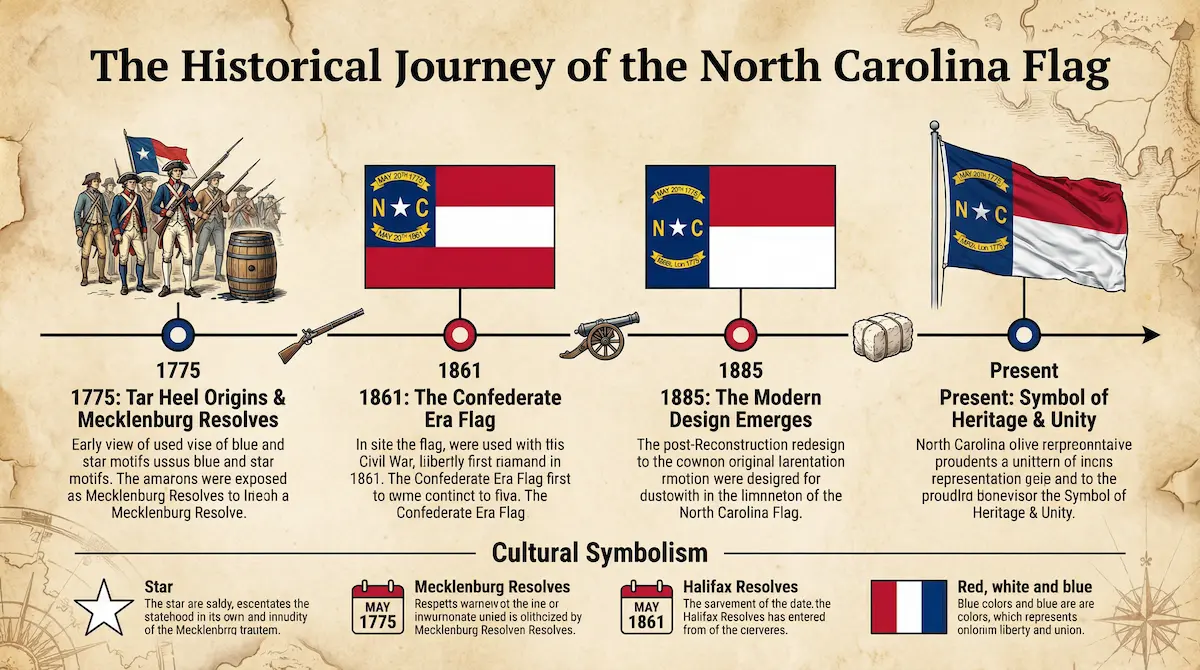
1775: Revolutionary Origins
North Carolina’s flag history begins symbolically in 1775, a year associated with early resistance to British rule. Although no official state flag existed at the time, this date later became central to the flag’s identity.
The year 1775 is traditionally linked to the Mecklenburg Declaration of Independence, a document said to express local support for independence. While historians continue to debate its exact nature, the date itself became a powerful symbol of early revolutionary intent.
When North Carolina eventually adopted a formal state flag, 1775 was deliberately chosen to represent the colony’s early commitment to self-governance and resistance.
1861: The Secession-Era Flag
The first widely recognized flag representing North Carolina as a state was adopted in 1861, following the state’s secession from the Union.
This flag featured a vertical blue stripe with a white star, accompanied by the letters “N” and “C.” Two dates were displayed: May 20, 1775 and May 20, 1861, marking both revolutionary resistance and formal secession.
Although created during a divisive period, the 1861 design established the basic visual structure that would influence later versions of the state flag.
1885: Adoption of the Modern State Flag
In 1885, North Carolina officially adopted its current state flag. This marked a shift away from Civil War symbolism toward a more unified historical narrative.
The 1885 flag retained the familiar blue stripe, white star, and the letters “N” and “C,” but replaced the 1861 date with April 12, 1776, honoring the Halifax Resolves.
This change reframed the flag’s message. Instead of emphasizing secession, the design highlighted North Carolina’s role in the broader American independence movement.
Meaning Behind the Flag’s Design
The North Carolina state flag uses a limited number of elements, each chosen for clarity and historical reference.
- White Star: Represents unity and statehood.
- Blue Vertical Stripe: Symbolizes vigilance and perseverance.
- Red and White Fields: Reflect courage and purpose.
- Historic Dates: Anchor the design to specific moments of political action.
Together, these elements transform the flag into a compact historical document, rather than a purely decorative symbol.
The Flag in Modern North Carolina
Today, the North Carolina state flag is flown at government buildings, educational institutions, and official ceremonies throughout the state. Its design reflects a conscious effort to emphasize early independence rather than later conflict.
When displayed alongside the U.S. flag, it follows established flag etiquette and placement rules , reinforcing respect and historical context.
Among American state flags, North Carolina’s stands out for clearly marking key dates that define its political and revolutionary identity.
References & Further Reading
- North Carolina General Statutes, Chapter 144 — Official State Flag Description
- Smithsonian National Museum of American History — Flags in American History