


The California flag is one of the most recognizable in the United States. Its imagery comes from a short but decisive period in the mid-19th century, and its modern form was officially fixed in the early 20th century.
1846: The Bear Flag Revolt
Short answer: California’s flag began as a revolutionary banner. In 1846, American settlers in Alta California raised what became known as the “Bear Flag” during a brief uprising against Mexican rule.
This event, later called the Bear Flag Revolt, lasted only a few weeks. However, the flag created during this moment left a lasting visual legacy.
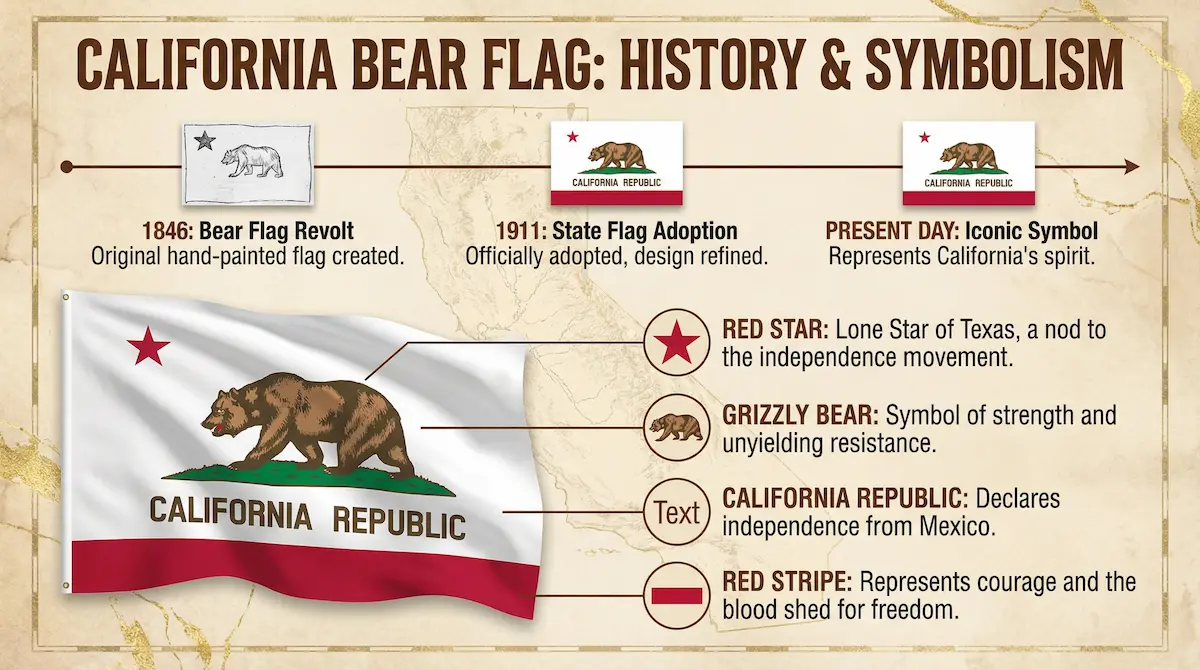
The original banner featured a grizzly bear, a red star, and the words “California Republic.” These elements were meant to signal independence and local authority.
Why the Bear and the Star?
Core idea: The symbols on the flag were chosen for clarity and strength.
The grizzly bear represented power and endurance. At the time, California grizzlies were widely known and seen as dominant animals in the region.
The single red star was likely inspired by earlier revolutionary flags, including the Lone Star used in Texas. It symbolized independence and self-rule.
Together, these symbols created a simple but direct message: California was asserting its own identity.
1911: The Official State Flag
Clear outcome: California officially adopted its state flag in 1911. This action standardized the Bear Flag design.
The law defined the exact elements of the flag: the brown grizzly bear walking on green grass, a red stripe along the bottom, a red star in the upper left, and the text “California Republic.”
This step was important because earlier versions varied in shape, color, and proportion. The 1911 law ensured consistency across government use.
Meaning of the Modern California Flag
Main meaning: The flag connects modern California to its brief period as an independent republic.
- Grizzly Bear: Strength and independence.
- Red Star: Sovereignty and revolutionary origins.
- Red Stripe: Courage and sacrifice.
- “California Republic”: Historical identity.
Even though the republic was short-lived, its symbols became central to California’s identity.
References & Further Reading
- Smithsonian National Museum of American History — California Flags in the Smithsonian Collection